Hyper-V VM Restore
Managed Backup supports the restore of Hyper-V Server or Failover Cluster virtual machines.
Note that item-level restore from long-term (cold) backup storages is not currently supported.
Step 1
After launching Backup Agent, you can run the Restore Wizard by clicking Restore on the Home tab of the horizontal menu.

Step 2
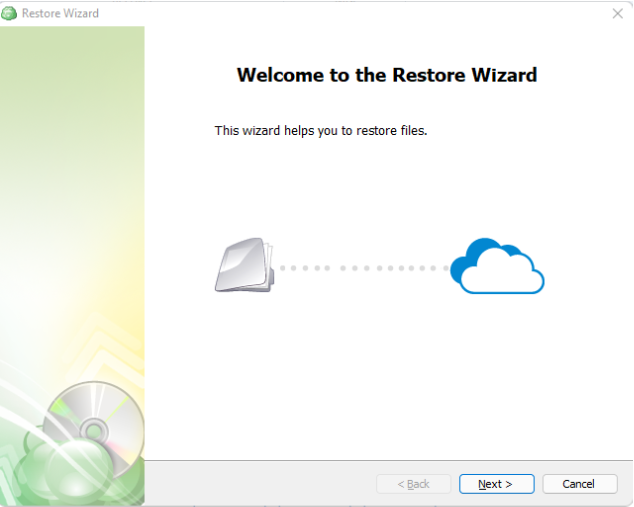
Click Next to advance past the welcome screen of the wizard.
Step 3
The next step will prompt you to select the source for the restore.
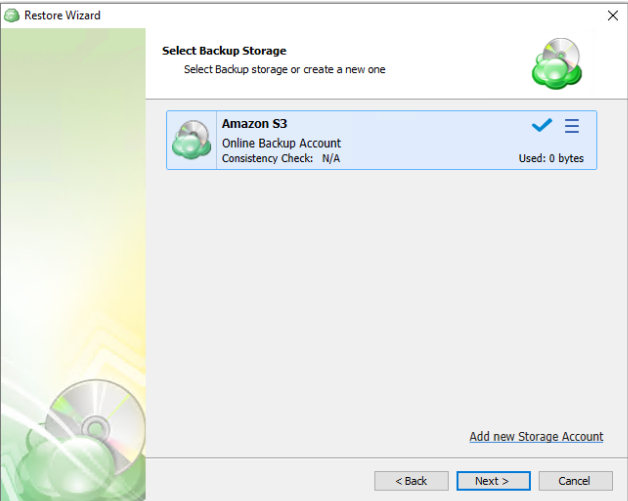
If the desired source is not in the list, you can click Add new Storage Account to add it.
- The backup storage is the one that contains the backup data.
- The required backup prefix is set for the storage account.
If necessary, switch the backup prefix.
Step 4
Once the source has been selected, the next screen allows you to choose between running the plan a single time or saving it for later use.
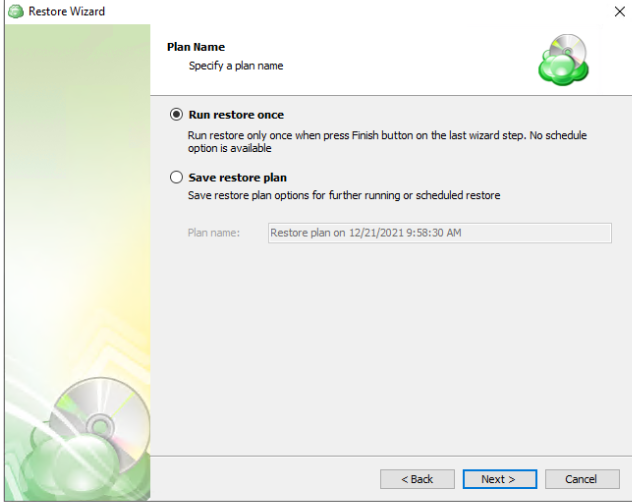
Run restore once will execute the restore immediately upon completing the wizard. There is no option to schedule this type of restore.
Save restore plan will allow you to schedule the plan to run at a later time and also schedule repeating restorations if needed.
Step 5
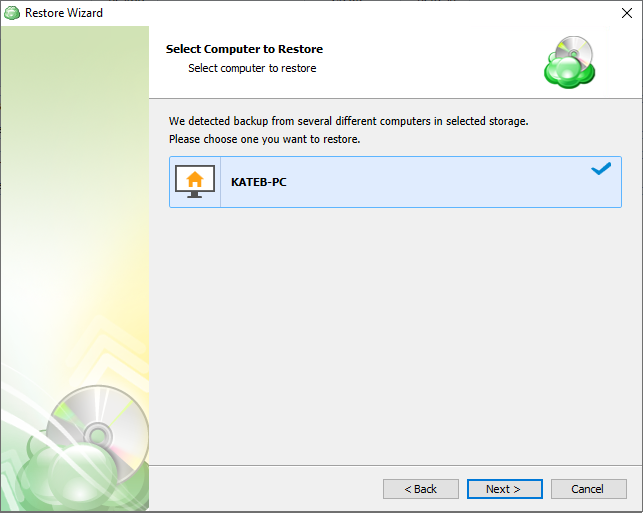
With the type of restore selected, the next step is to select the correct host server on which the VM resides.
Step 6
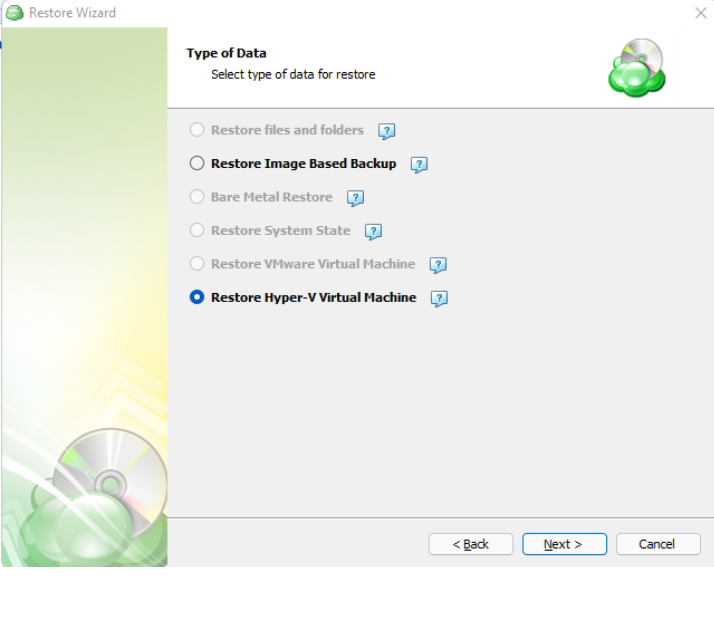
Next, you will be presented with a list of available backup types for the selected host. Select the Restore Hyper-V Virtual Machine option to continue.
Step 7
With the correct type of restore selected, the application will generate a list of available backup plans to restore from.

Step 8
Next, you will be given a choice of what point in time you would like to restore the VM to.
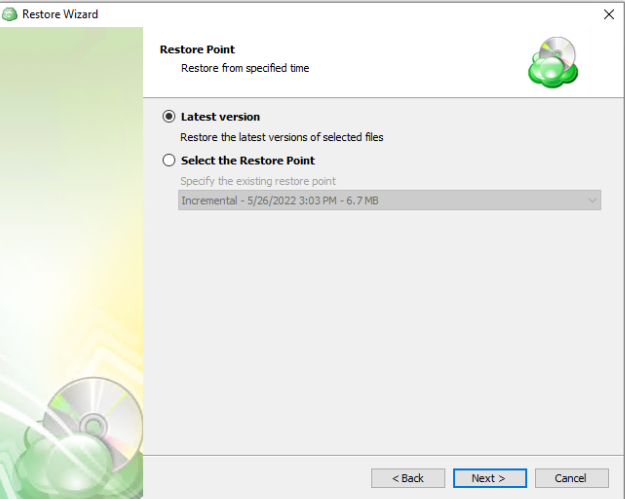
- Latest Version: Automatically restores the newest version of each file in the source regardless of which restore point it belongs to.
- Select the Restore Point: Restores the files as they existed at the specified restore point.
If there is no exact match for the point in time selected, the application will automatically select the closest previous restore point.
Step 9
Next, you will be able to expand the list of VM backups on the selected host and choose which to restore.

Step 10
After selecting the files or folders to restore, you can select the restore type. In this example, we perform the restore as an imported Hyper-V machine.
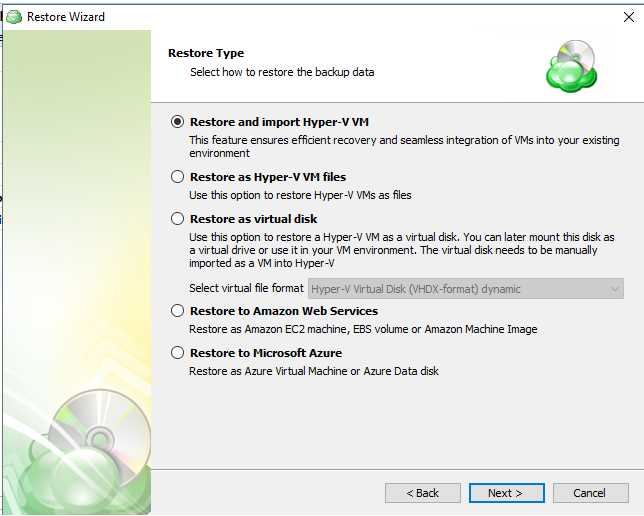
Restore and import Hyper-V machine: Selecting this option restores the virtual machine configuration as well as the virtual disks as files. Use this option to have the VM automatically imported to the hypervisor.
Restore as Hyper-V VM files: Use this option to restore Hyper-V VMs as files.
Restore as virtual disk: Restores the virtual disks in the backup as files that can later be mounted to a VM. No configuration files are included. Several formats are available:

- Restore to Amazon Web Services: If enabled, this will restore the selected VM directly to the AWS Cloud as an EC2 instance, EBS volume, or AMI.
- Restore to Microsoft Azure: This will restore the VM directly to Azure as either an Azure Virtual Machine or Azure Data disk.
Step 11
The next step is to select the disks to be restored.
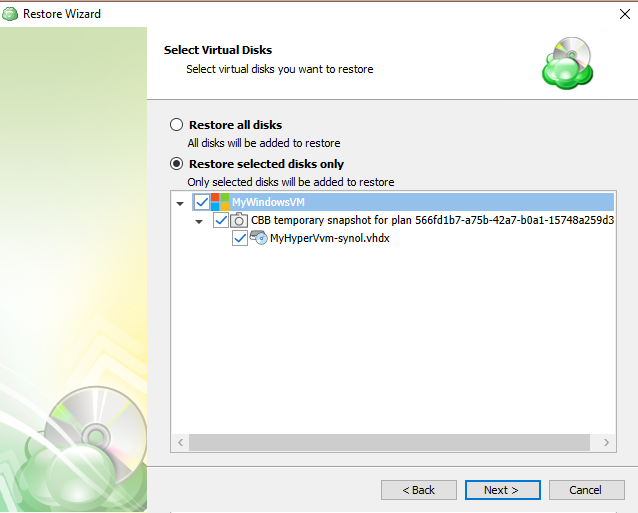
Here you can choose whether to restore all virtual disks associated with each selected VM or only restore selected disks.
Step 12
The next step is to choose a destination for the restored VM or virtual disk. You will be asked whether you would like to overwrite the VM. If you wish to restore it under a different name or to a different target VM, select or type over the value in the Restore as list.
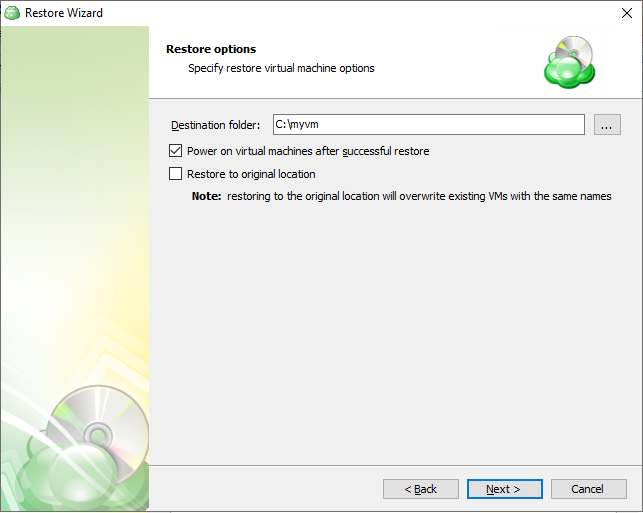
Step 13
After selecting the destination and any associated options, you will be prompted to provide the password to decrypt the VM backup data, if encrypted.

Step 14
(Optional) If you restore data from the S3 Glacier Flexible Retrieval or Glacier Deep Archive storage classes, specify Smart Restore options.
Step 15
If Save restore plan was selected at the start of the wizard, the next step is to set the schedule for the restore plan. Otherwise, this step will be omitted.
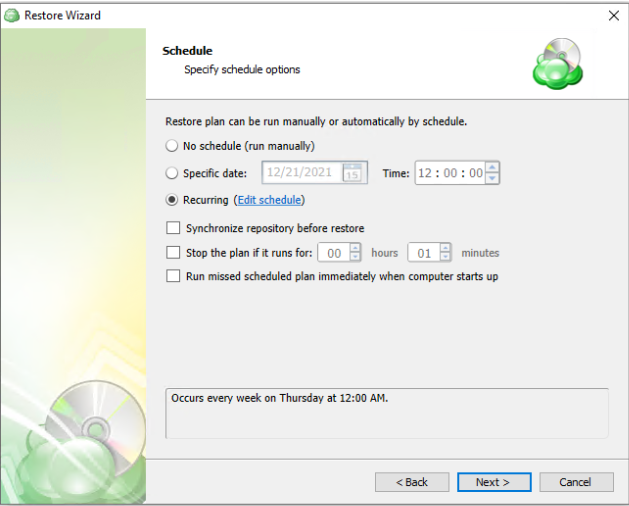
- No schedule (run manually): Use this option only when you wish to execute the restore manually.
- Specific date: Use this to schedule a one-time restore at the specified date and time.
- Recurring: This option enables you to schedule recurring restorations based on the criteria in the fields below.
- Synchronize repository before run: Enable this option to ensure the file tree reflects the latest modifications made to your storage. It is a good practice to use it when you restore to a different computer.
Do not use the Stop the plan if it runs for: option if you have a slow or unstable internet connection.
Enabling the Run missed scheduled restore immediately when computer starts up option will ensure that the restore plan will begin automatically after the computer starts up if it was unable to run at the scheduled time. This is only recommended for desktops and laptops. For servers, it is recommended that you run the restore plan manually when all maintenance work is completed to avoid adversely affecting server performance and internet bandwidth during working hours.
Step 16
The next step is to set any custom scripts which should execute before and/or after the restore plan runs.
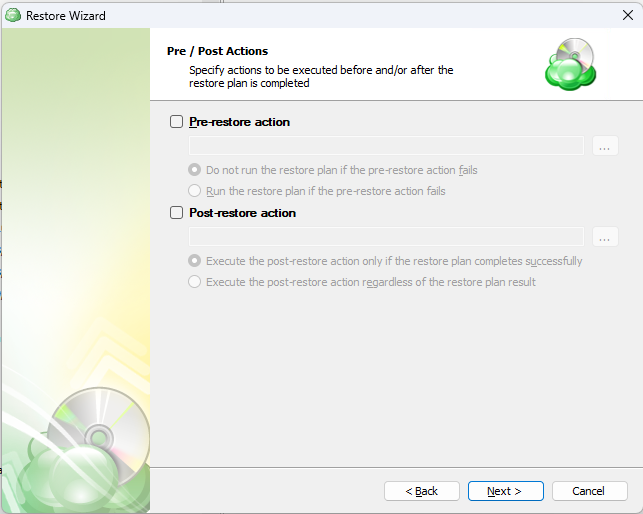
Step 17
Specify the notification options, then click Next.
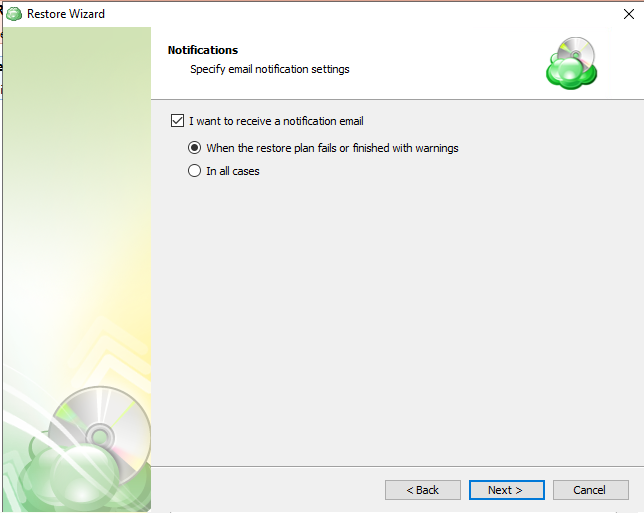
Step 18
The next step of the wizard displays a summary of the selections made throughout the process. Once you have reviewed your selections, click “Next”.
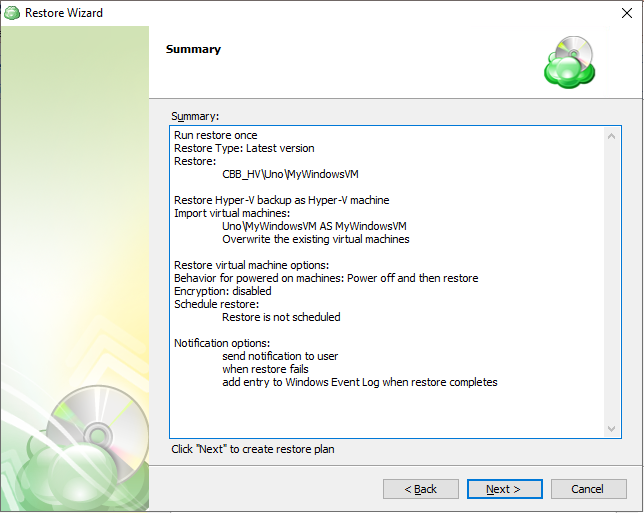
You can see the saved plan on the Restore Plans tab. If Run restore once was selected at the beginning of the wizard, the plan will immediately execute once you click Next.
Edit a Restore Plan
To edit the restore plan, proceed as follows:
- Switch to the Restore Plans tab.
- Open the restore plan you want to edit by expanding it, then click Edit.
- Proceed through the Restore Wizard steps to adjust settings as needed.
- If the plan is currently running, you'll need to select one of the following options:
- Apply changes after the restore plan completes
- Stop the plan and apply changes.
- After choosing the desired option for the running restore plan, click Apply.
- Save the edited plan configuration.
You can edit certain scheduled restore plan parameters directly, without using the restore wizard, as long as the restore plan is not currently running. Editable parameters are marked with a pencil icon. To make a quick edit, simply click the pencil icon next to the parameter.
Delete a Restore Plan
To delete the restore plan, proceed as follows:
- Switch to the Restore Plans tab.
- Open the plan to delete, expand it, then click Delete.
- Click Yes to confirm the restore plan deletion.