MSP360 Control Mobile App (iOS)
This chapter covers the following topics:
- MSP360 Control key features
- Install MSP360 Control
- Log In
- Dashboard
- Notifications
- View Computers
- Confirm 2FA Actions
- Add New Device
- Application Settings
Key Features
MSP360 Control (formerly MSP Admin) for iOS key features are:
- Remote monitoring of users' computers
- Remote backup/restore plan execution
- Enhanced 2FA management
- Push notifications for alerts and events if enabled.
- Latest news, notifications, and changelogs
- Customizable dashboard on home page
| Top |
Install MSP360 Control
MSP360 Control requires iOS version 17.6 or later.
To install the MSP360 Control application, proceed as follows:
- Scan the QR code on the dashboard page of the Management Console, or find MSP360 Control in the App Store.

- Tap the Get button.
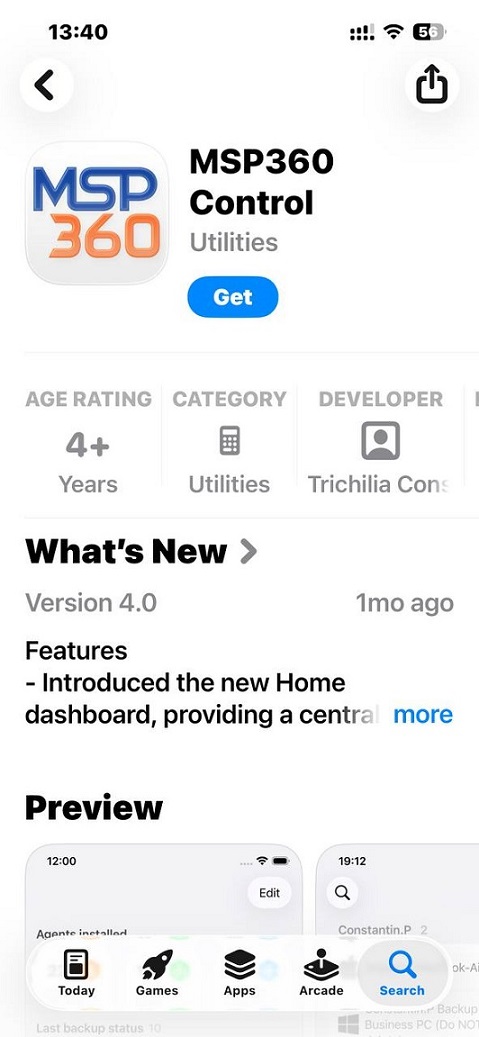
- As the installation completes, tap Open.
| Top |
Log In and Initial Setup
You can log in using two options:
- Provide the email address and password you use to authenticate in Managed Backup
- Sign in using Google or Microsoft Single Sign-On (SSO)

- Enable push notifications
- Enable MSP360 Control to send you notifications
- Enable access to the camera
- Scan the QR code (it is shown in the Management Console)
- After logging in, configure the PIN and Face ID. The user should grant Apple permission to use Face ID and then set up a PIN.

If Face ID permission is granted, the PIN will only be requested when the face cannot be recognized.

| Top |
Dashboard
The home page of the MSP360 Control mobile app contains a customizable dashboard with the following information:
- Agents installed
- Storage consumption
- Storage accounts
- Last backup status
- RMM alerts
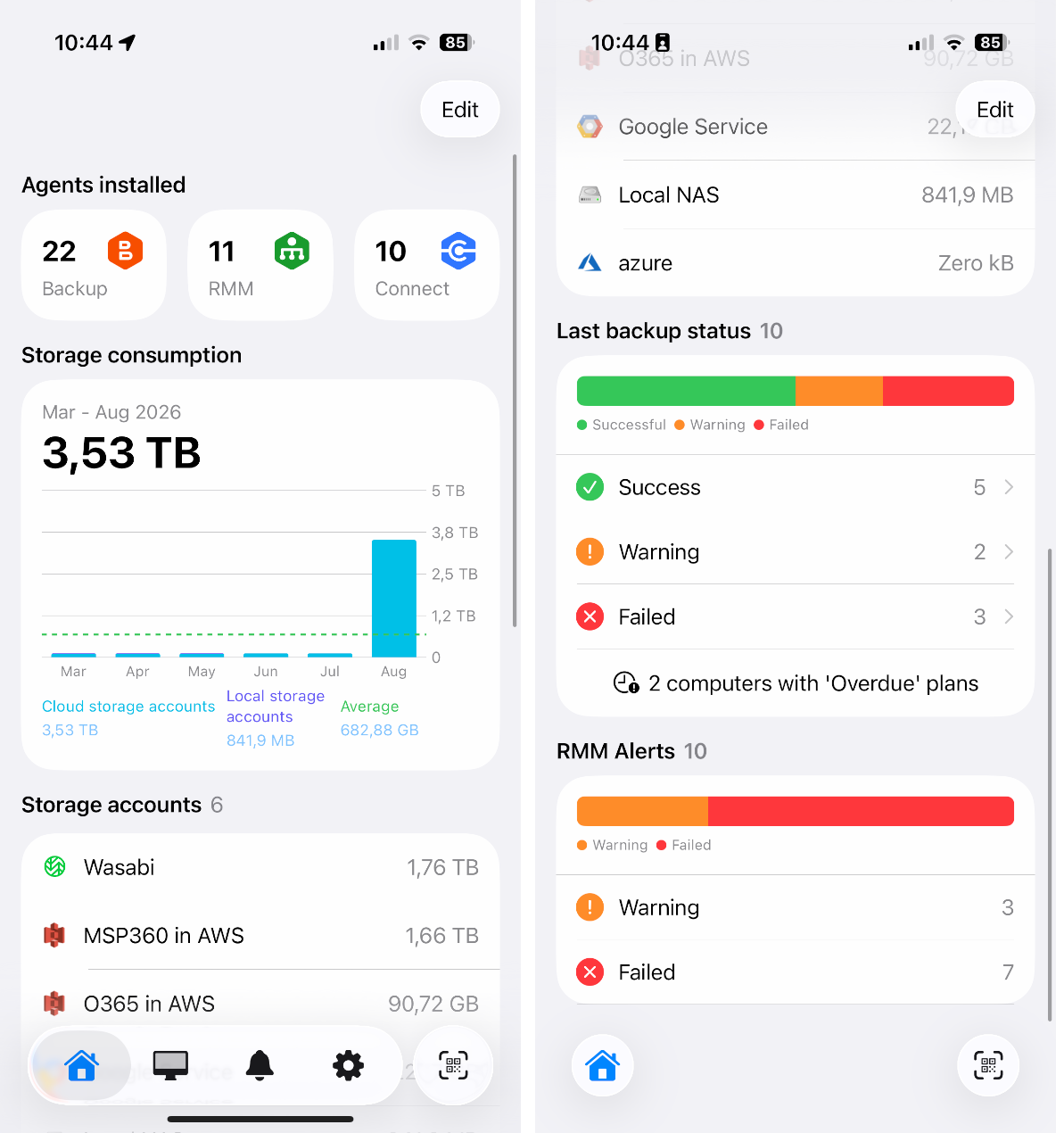
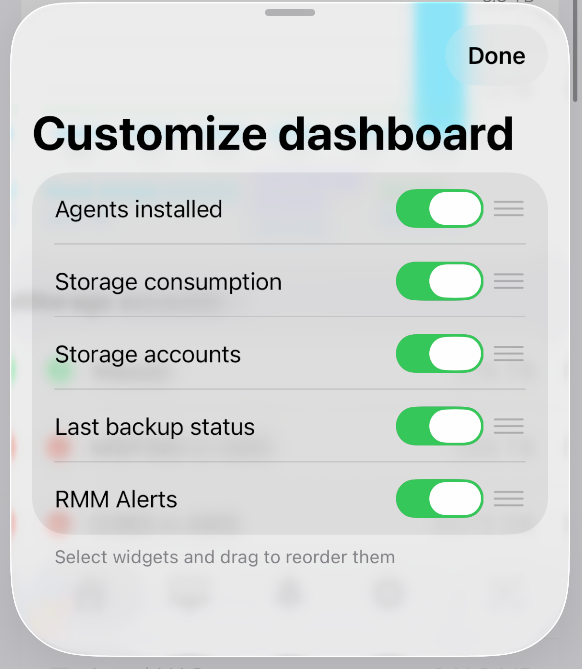
To customize the dashboard, use Edit in the top right corner, select the required information blocks and clear the blocks you do not need.
| Top |
Notifications
View the event notifications in your MSP360 Control application.
To view notifications, tap the bell icon in the application.

To get the details of the event, tap it.
View Computers
You can perform some basic actions with your users' computers.
To manage computers and their backup/restore routines, tap the computer icon in the application.
Users' computers are grouped by company. Find the required company in the list, then find the computer to view and manage.
You can view the computer's backup and restore history (failed and successful plans are displayed with different colors). To view the plan details, tap it: the expanded page contains comprehensive information on the plan.
For example, the detailed plan information on file backup contains the following data:
- Plan status
- Plan type
- Storage account
- Last run
- Plan duration
- Last result (success, error message, or warning)
- Number of files backed up
- Number of failed files
- Number of copied files
- Copied size
- Backup size
- Total size
- Date and time of the next plan start

Create Remote Desktop Connections to Computers
To manage computers and their backup/restore routines, tap the computer icon in the application. Users' computers are grouped by company. Find the required company in the list, then find the computer to view and manage. To create a remote desktop connection to computer. This feature requires any backup license, Connect, or RMM + Connect license assigned to the computer.
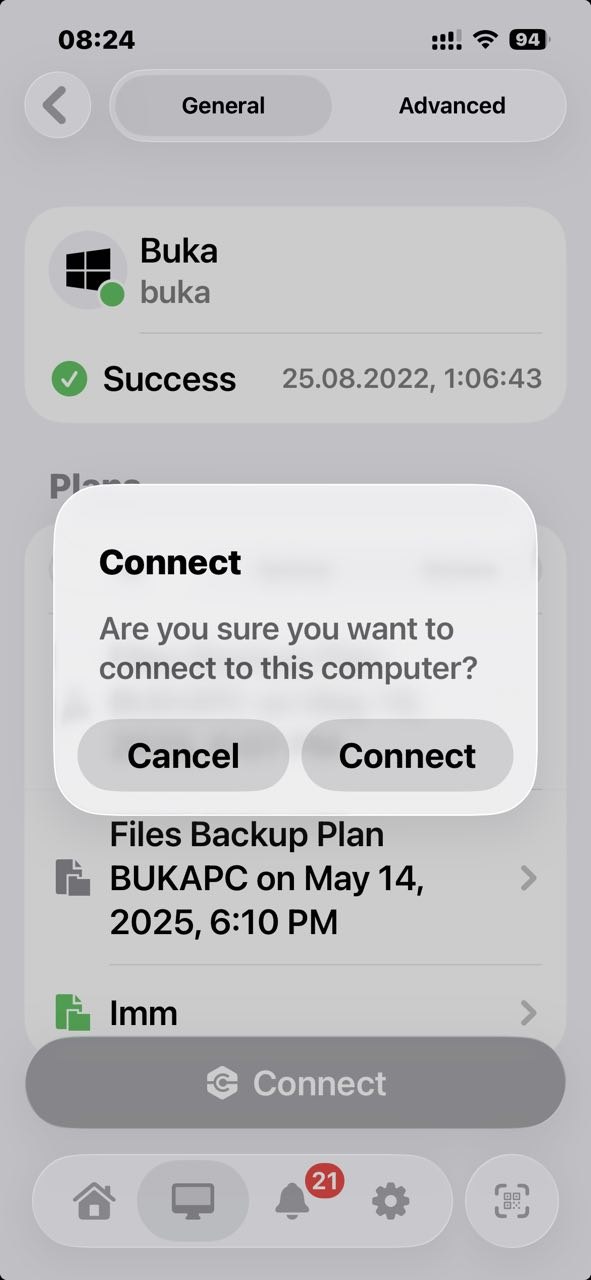
- Click the Connect button on the bottom.
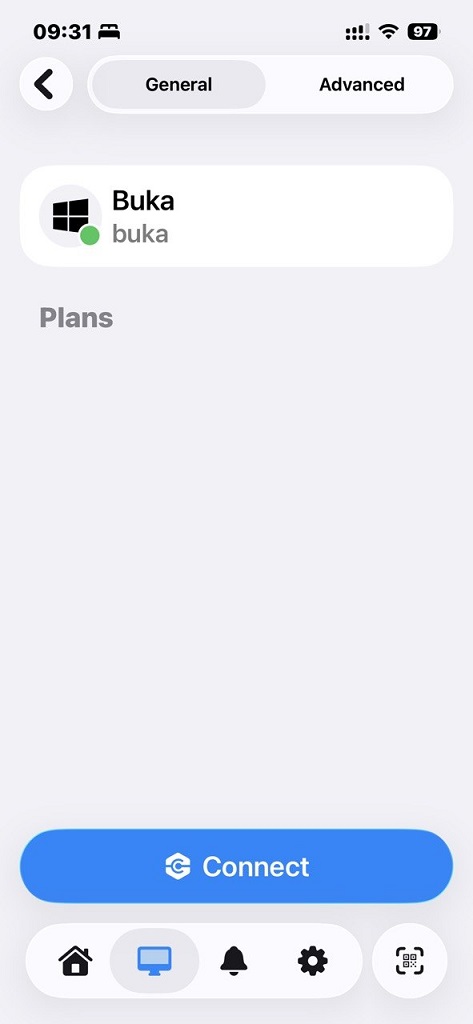
- Confirm the connection.
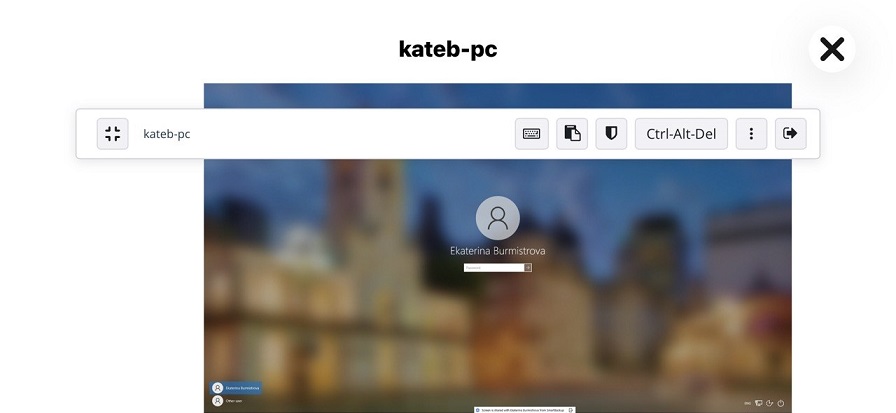
- Provide credentials to open the session.
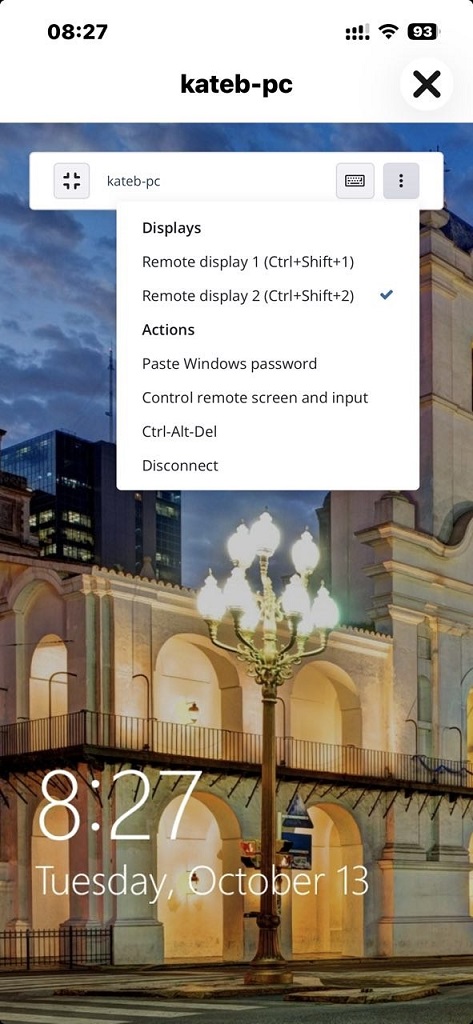
- From session menu you can:
- Paste Windows password
- Control remote screen and input
- Toggle full screen mode
- Disconnect the session.
For the full list of session options, refer to the In-Session Options article.
- You can also use Use CTRL+ Alt+Delete to access the following menu:
- Lock. Stops others from accessing a computer until the user signs back in.
- Switch User. Enables another user to use the computer without closing all applications and windows of the current user. These remain open in a suspended state -not visible to the new user -for when they switch back to the previous user.
- Sign Out. Signs the user out of their account; closes all application windows.
- Change Password. Enables the user to change the password when using an offline account on their PC. Forgotten passwords cannot be reset here, however, as the user must know the current one to change it.
- Task Manager. Brings up the Task Manager Windows tool for managing running applications, processes, and services.
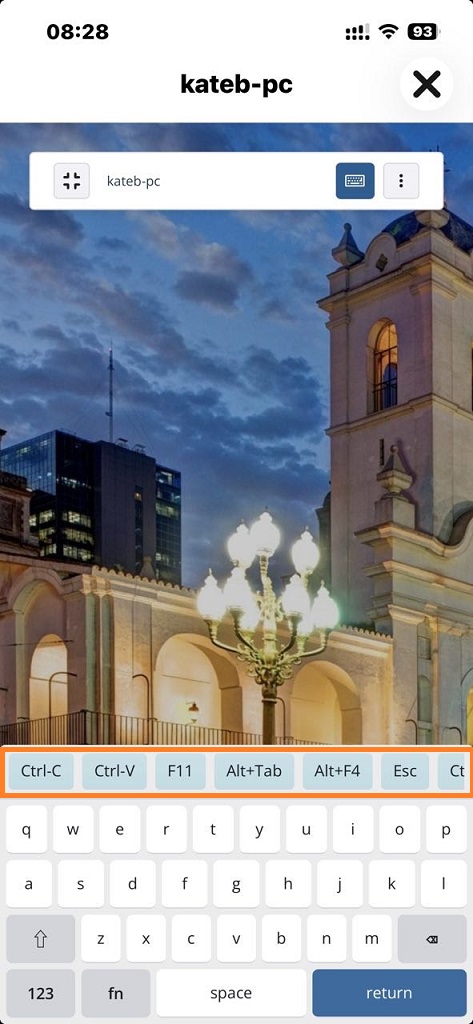
- Other keyboard shortcuts are available to simplify session management.
Run Plan
With MSP360 Control, you can run the backup/restore plan on the user's computer at any time. Tap the computer icon, find the required computer, then find the required plan in the list, then tap the play icon.
The plan results appear in the Notifications section once the plan is complete.
View Computer State
You can check the health of the computer. To do this, find the required computer, tap it, then tap the Advanced tab.

Confirm 2FA Actions
If you use the MSP360 Control application for 2FA purposes and are logged in to the MSP360 Control app, you can scan the QR codes displayed in the confirmation request in the Management Console to approve the action.
Notifications about events in Managed Backup will also appear on the device where the application is installed. To confirm or reject an action, unlock the device.
Open MSP360 Control, then in the notification, select whether to confirm or decline the action. You can view the history of confirmed or declined requests in Notifications.

As you confirm the action, the mobile application sends a confirmation to the Management Console, and the action is allowed for execution. If no confirmation arrives, the rejection message is sent to the Management Console and is written to the Audit Log.
| Top |
Add New Device
You can have several devices in the device list for notification purposes (for 2FA confirmations, only one device is allowed). To do this, proceed as follows:
- Open the Management Console.
- In the Settings menu, select General.
- In the right pane, find the device list. As you enable 2FA for the first time, it is empty.
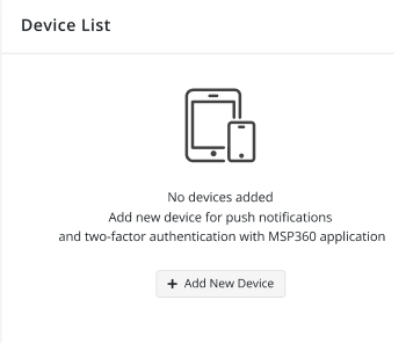
- Click Add New Device.
- Proceed with adding your device with the installed MSP Control as described in the Add New Device dialog.
- Open MSP360 Control, proceed with automatic authentication, or scan the QR code.
- Confirm the action with the device you use for 2FA confirmations.
If you use more than one device for 2FA purposes, refer to the Manage Devices chapter.
| Top |
Application Settings
Configure the application settings. To do this, proceed as follows:
Open MSP360 Control (MSP360 Control icon).
Tap the Settings icon.
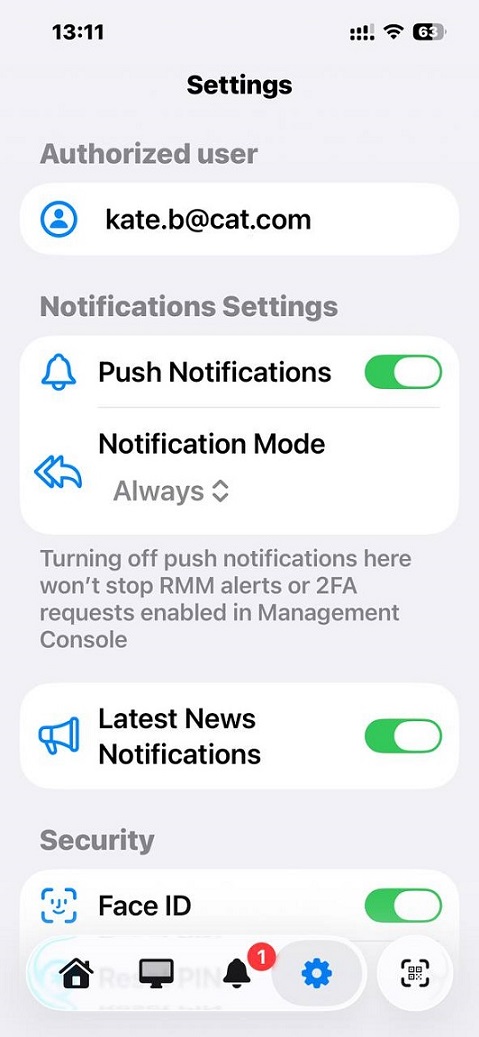
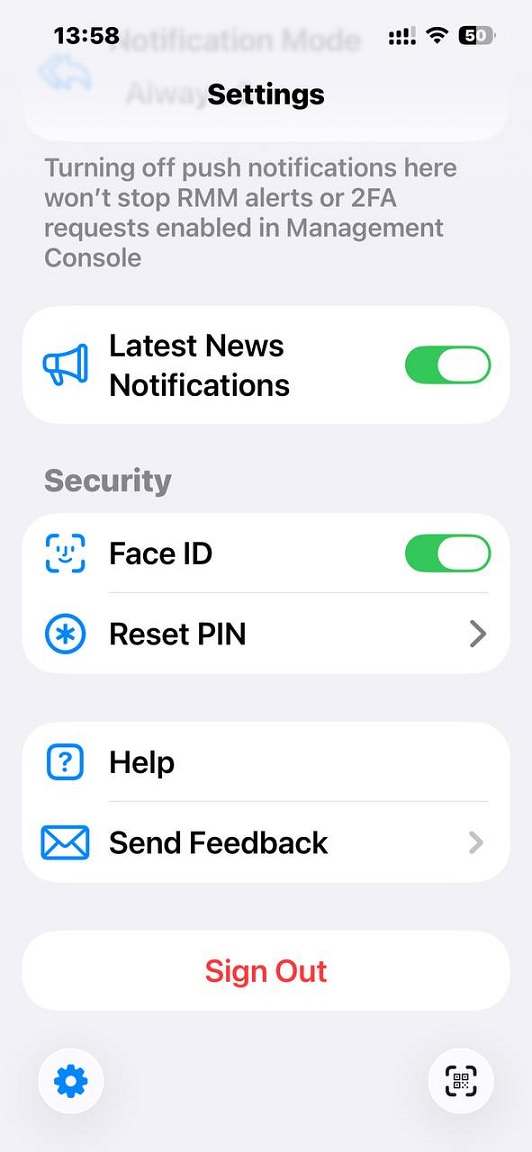
Configure / edit the application settings:
- Push Notifications. You can enable/disable push notifications (2FA confirmation requests arrive regardless of this setting)
- Notification mode. In this group, you can specify the category of notifications you want to receive (2FA confirmation requests arrive regardless of this setting)
- Latest news notification. Allows sending push notifications about the latest MSP360 releases
- Face ID. Enable it if your device supports Face ID authentication and you want to use it
- Reset PIN. Allows you to reset the current PIN
- Help. If you experience some difficulties with the application, you can open the help documentation to resolve the issue and fix it.
- Send Feedback. If you have inquiries or issues, this option helps you send an email with a description of the problem. Expand it to enable logs and configure the log level (by default, logs are enabled with the Error level). Use the Send Feedback option to send the email with attached logs.
You can sign out of your account with Sign Out, if needed.
Expand Send Feedback to configure logging. If you experience issues with the application, you can review the logs to help identify and resolve the problem. Logs can be sent by email (if enabled), downloaded, or cleared using the Remove Logs option.

| Top |