About GFS
What Is GFS?
The Grandfather-Father-Son (GFS) policy features custom purge delays for some full backups to comply with archive storage requirements and optimize storage costs. Along with the regular retention policy, the GFS retention policy keeps a balance between backup data availability and storage expenses.
There are three different GFS retention periods in the GFS policy:
- Yearly (grandfather)
- Monthly (father)
- Weekly backup (son)
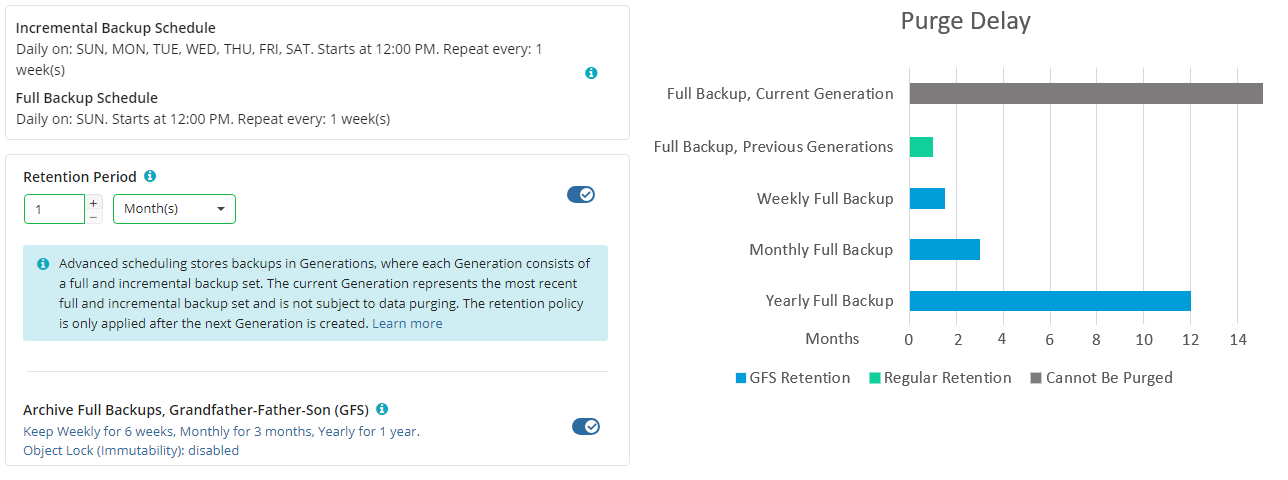
According to the GFS policy settings, some full restore points are subject to a purge delay that is different from the regular retention policy. The purge delay for full restore points selected according to the GFS retention policy can include the GFS delay and regular retention depending on the GFS settings. For better comprehension, view the diagrams below.
For the rest of the full backups excluding the current generation, the purge delay is determined by the regular retention policy settings.
Scheme 1
Scheme 2
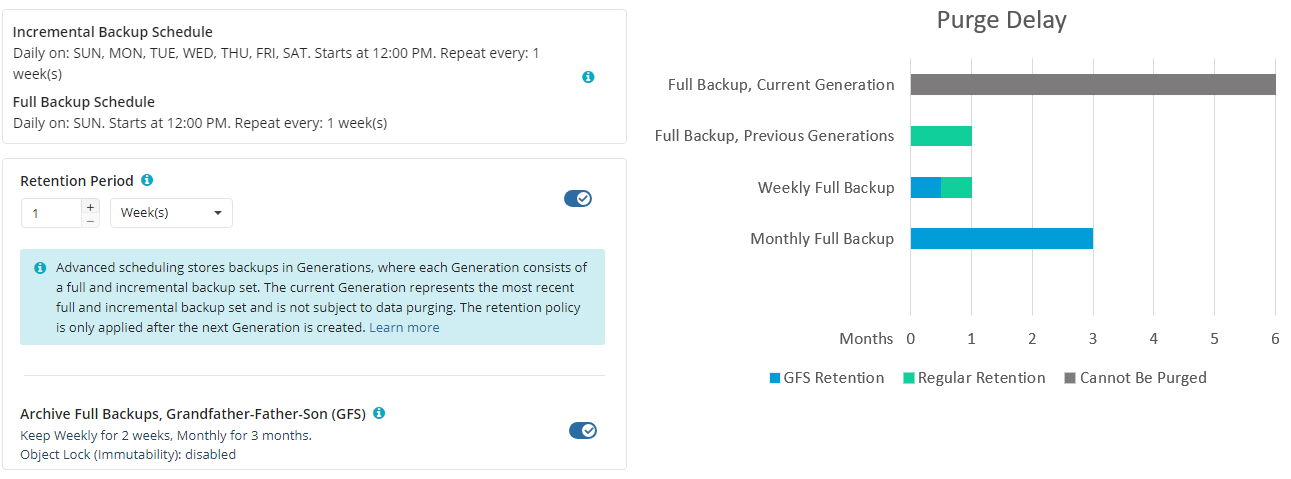
The weekly, monthly, and yearly GFS retention periods are selected automatically according to the specified GFS settings. You can configure the custom purge delays for weekly, monthly, and yearly full backups marked as GFS restore points. Weekly backup is selected automatically and is retained on a weekly basis, monthly backup is selected automatically and is retained on a monthly basis, and yearly backup is retained annually.
The GFS policy is supported in the new backup format (NBF) only.
The GFS retention policy is supported for the following backup types:
- Files backup
- Image-based backup
- VMware backup
- Hyper-V backup
How GFS Works
To apply the GFS policy, a full backup dataset is required. These backups must be completed without errors and warnings. If errors or warnings occur during the backup, in most cases you are provided with solutions to resolve them.
At the end of backup plan execution, if the backup procedure is completed successfully and the GFS policy is enabled, the GFS search mechanism checks if any GFS retention periods can be assigned to the generation of this backup plan.
For more information about GFS retention period assignment, refer to the GFS Retention Period Assignment paragraph.
After the GFS retention period is assigned, it remains unchanged until the end of this period. This means that even if you change your GFS settings later, the GFS retention period will not change.
For example, if the following retention settings are set and the weekly GFS retention period is enabled:
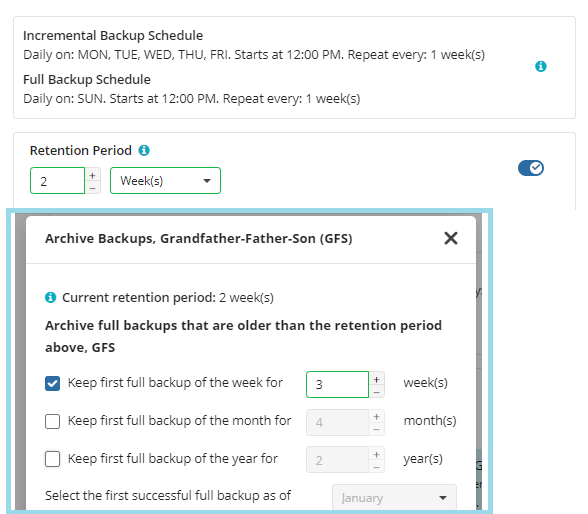
The search for a weekly backup started on Sunday, March 21, 2021, but for some reason, the first successful backup was completed on Friday:

This backup will be marked as a GFS weekly backup.
This backup will be kept until April 16, 2021, regardless of whether the GFS policy is disabled or changed later.
Subsequent incremental backups made by this backup plan will be kept for the default retention period specified in the backup plan (according to the specified general retention policy):

GFS Retention Period Assignment
The GFS retention period assignment engine runs at the end of any backup plan run for backups that match all criteria (successful backup with full backup dataset).
The successful backup date is always the date of the backup plan start (some backup plans can last more than a day).
The GFS retention assignment engine searches for successful restore points according to the rules listed below:
- A weekly backup is searched for and assigned as of Sunday. If a monthly or yearly backup is already marked in the current week, a weekly GFS retention period will be assigned in the next week.
- A monthly backup is searched for as of the first day of the month, provided no yearly backup is marked for this month. If a weekly backup is already marked for the current week, the monthly backup is searched for as of the next Sunday. If a yearly backup is marked for this month, the monthly backup is searched for as of the next month.
- A yearly backup is searched for as of the first day of the month specified in GFS settings. If there are no successful backups in the specified month, then the first successful backup in the next month will be marked as yearly for this year.
Once a GFS retention period is assigned, it is never changed.
- If yearly and monthly GFS retention periods are enabled, and no month for the yearly retention period is selected in GFS settings, then the first successful restore point of the first week of the year will be marked as a yearly backup (provided this week contains no other restore points marked for the GFS policy; this may occur if a year begins in the middle of the week). If a GFS restore point already exists for the selected week, the first yearly backup is searched for as of the next Sunday. Once the yearly restore point is marked, the search for the first successful monthly restore point starts on the Sunday following the yearly backup selection.
- If yearly, monthly, and weekly GFS retention periods are enabled and a specific month for yearly backup is not set in GFS settings, then the first successful restore point of the first week of the year will be marked as a yearly backup (provided this week has no other backups marked for the GFS policy; this may occur if a year begins in the middle of the week). If a GFS restore point already exists for the selected week, the first yearly backup is searched for as of the next Sunday. Once the yearly backup is marked, the search for the first monthly backup starts on Sunday of the following week. Finally, the first weekly backup is searched for as of the Sunday after the yearly and monthly backups are selected.
Refer to the Examples for more information.
Weekly (Son)
A weekly restore point is marked once a week, on Sunday.
A restore point with a weekly GFS retention period is kept in backup storage for a specified number of weeks. The GFS retention period for this restore point remains the same even if the GFS policy is disabled or changed. If there are no successful restore points that comply with the GFS policy criteria within a week, no restore points will be marked with a weekly retention period.
For the weekly GFS retention period, full backups must be scheduled at least once a week.
Monthly (Father)
A monthly restore point is marked once a month.
The first successful restore point that complies with the GFS policy will be marked as monthly.
The monthly restore point selection can be postponed to the first Sunday if the weekly restore point is already selected for the first week of the month. If there are no restore points that comply with the GFS policy criteria in January, then no monthly restore points for January will be assigned.
A monthly restore point is kept in backup storage for the specified number of months. The GFS retention period for this restore point remains the same even if the GFS policy is disabled or changed.
For the monthly GFS retention period, full backups must be scheduled at least once a month.
Yearly (Grandfather)
A yearly restore point is selected once a year starting from the month specified in the GFS settings (from January to December).
To avoid assigning yearly full backups in a row, it is not recommended to set yearly GFS to the month following the one in which the yearly GFS was enabled.
The first successful restore point that complies with the GFS policy and with user settings (you can select the month from which the yearly restore point will be selected) is selected as yearly.
The yearly restore point selection can be postponed to the first Sunday if the weekly restore point is already selected for the first week of the year.
A yearly restore point is kept in backup storage for the specified number of years. The GFS retention period for this restore point remains the same even if the GFS policy is disabled or changed.
For the yearly GFS retention period, full backups must be scheduled at least once a month.